
The hectic life, the excess of work and the arduous routine are some of the causes for couples to spend less time together. Many times the relationship is taken for granted and they stop trying to make a space to share with the couple the talks, moments and laughter that were frequent in the courtship.
Healthy marriages are not only sharing time together because they are happy but because they like their partner’s company, enjoy that common space and have marital satisfaction (Johnson, M. D., & Anderson, J. R. 2013). Generally, most couples prefer to keep distance when there is friction and when everyday life becomes boring and tedious. In contrast to this, healthier and better-linked couples, despite having emotional problems or injuries, solve everything by spending more time together (Sanford, K. 2006).
The big secret of spending time together, both consciously and unconsciously is to keep working on your friendship and to not take it for granted. It is illustrated in the study conducted by Dr. Wilcox of the University of Virginia (2005) to married couples where he found that those couples who spent some time talking or sharing an activity at least once a week showed a trend 5 times more likely of being «happier» in their marriages than those who did not.
In several studies, the time that couples spend together has been related to marital satisfaction (Johnson, M. D., & Anderson, J. R. 2013). When couples have regular dates show that their marriage is their priority and that results in a stronger marriage. So for those who want to learn to spend quality time and foster a friendship with their partner, to improve their relationship here is shared the following:
Best friend:

Who is happily married looks at his partner as the best and closest of his friends, a friend who wants to keep close no matter what (BEEKE, J. R. (2017). It’s funny how many couples strive to maintain the rest of their friendships. They make a space to have a coffee without letting all the problems get in the way, why often the same cannot be done with the husband? Why not forget the phrase: «I don’t have time, my love, another day»
Quality spaces:

Marriages need those spaces of quality, not just quantity. The moments that are shared are times to connect, pay attention and know-how they have been. In these quality spaces, talk about each other, focus on each other without diverting attention from the relationship (Doherty, William J., 2001).
Do things together:

Many marriages are in the same house and do not share mealtimes, do not watch programs in common or coincide in their schedules. Those spouses live together as strangers. Unlike them, couples who have their marriage as a priority do things together regardless of the simplicity of the actions (Carraway, A., & Carraway, B. (2017). One wife said that for her, having coffee with her husband on Sunday morning reading the newspaper was something she loved. This made her feel that they were connected.
Dr. William Doherty, PHD Family Social Science University of Minnesota shares 10 commandments for dating your spouse ( Zeig, J. K., & Kulbatski, T. 2012) that seems very interesting and helpful.
So here is a list of ideas for date night for couples and a calendar to schedule at least one monthly date.
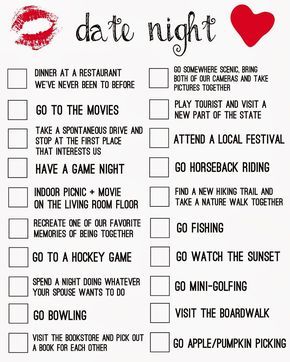
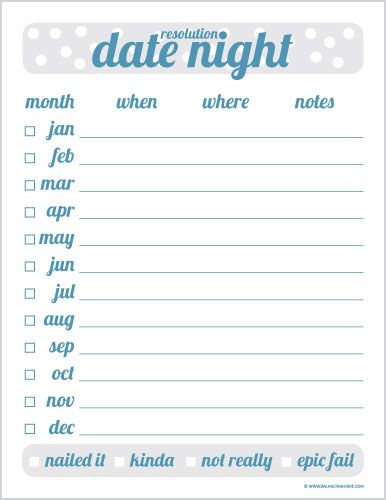
DATE NIGH IS CHEAPER THAN DIVORCE
Don’t forget to give our opinion in this link. https://byui.az1.qualtrics.com/jfe/form/SV_9SjnPyoBVTZskzX
REFERENCES
BEEKE, J. R. (2017). Nurturing Intimate Communication with Your Spouse. Puritan Reformed Journal, 9(1), 265–278. Retrieved from https://search-ebscohost-com.byui.idm.oclc.org/login.aspx?direct=true&db=rlh&AN=120832245&site=eds-live
Carraway, A., & Carraway, B. (2017). Cheers to eternity : lessons we’ve learned on dating and marriage. Springville, UT: CFI. Retrieved from https://search.ebscohost.com/login.aspx?direct=true&db=nlebk&AN=1793471&site=ehost-live
Doherty, William J., (2001). Take back your marriage: sticking together in a world that pulls us apart. New York: Guilford.
Johnson, M. D., & Anderson, J. R. (2013). The longitudinal association of marital confidence, time spent together, and marital satisfaction. family process, 52(2), 244–256. https://doi-org.byui.idm.oclc.org/10.1111/j.1545-5300.2012.01417.x
Sanford, K. (2006). Communication during marital conflict: When couples alter their appraisal, they change their behavior. Journal of Family Psychology, 20(2), 256–265. https://doi.org/10.1037/0893-3200.20.2.256
Institute for American Values, 2005 Why marriage matters, second edition: twenty-six conclusions from the social sciences Family Scholars 44 pages https://irpcdn.multiscreensite.com/64484987/files/uploaded/Why-Marriage-Matters-Third-Edition-FINAL.pdf
Zeig, J. K., & Kulbatski, T. (2012). Ten commandments for couples: For every aspect of your relationship journey. Phoenix, Ariz: Zeig, Tucker & Theisen.
 MARRIAGE FIRST
Thank you for the advice!
Me gustaMe gusta