
Nobody said that marriage was easy. Anyone who has been married for many years knows this. At first, everything is fantastic, everything is beautiful! Everything is so beautiful and so fantastic that the couple desires to spend much more time with each other; but then they discover that the more time they spend together, the more “defects” they find with each other. Their differences in opinion become more apparent and numerous.
Having differing opinions or views is normal. Having conflicts is a natural part of the human condition. It reflects that the people care about their points of view, priorities, and values; but when in conflict one must learn to handle them with respect and grace. Negative consequences of conflicts are avoidable. Since conflicts go from anger, anxiety, stress, and sadness to divorce (McCormick 2017), obtaining tools to deal with conflicts more effectively is paramount.

There are many factors in marital conflicts, according to a study that was conducted in the city of Nuevo León, Mexico. The study indicates that the three main factors of marital conflicts are: lack of understanding, lack of communication, and incompatibility of characters. These are rather structural in nature. Or in other words, as defined by the American Dr. John Gottman (Gottman, 2015) «soluble» and «insoluble.»
There is a recent study also by Dr. Gottman (Gottman, 2015) where four behaviors were detected that, when observed in a couple, were safe predictors of divorce. These, called by Gottman are «The 4 Horsemen of the Apocalypse»:
1. Contempt
Much more serious than disgust, it is contempt that becomes superior. It is to look at the other as below oneself and to feel better than, more intelligent than, more sensitive than the other. When the couple communicates from contempt, they are sarcastic, mocking, disrespectful, and even cruel.
2. Criticism
There is a difference between telling your partner, «When you do not arrive at the time you promised, I feel very distressed. I worry that something bad has happened to you,» and saying, «I cannot trust you. You never keep your promises. You do not even care if I worry about you. You only care about yourself.” A disagreement can be expressed, even a complaint, but the criticism is especially harmful because the person is labeled and judged negatively.
3. Defensiveness
This attitude denies the responsibility in the conflict; and therefore, does not assume its part in learning or changing to solve it. «Being on the defensive,» normally, brings with it disrespectful attitudes toward the other; since it considers that it was the other who started the conflict. Being on the defensive only causes problems to grow and not reach resolution. Gottman highlights the importance of the responsibility of each member of the couple to take charge of the situation and solve it in the best possible way.
4. Stonewalling
Stonewalling represents the fourth and last horseman. Stonewalling is when a couple’s discussion ends when one of the two is silent, pulls out a cell phone and starts playing/browsing/watching videos, or where one or both of them withdraw from the discussion, close in on themselves, and leave the other out. Running away from problems only allows them to accumulate, further increasing the hurt feelings of those who feel rejected, ignored or despised.
What to do?
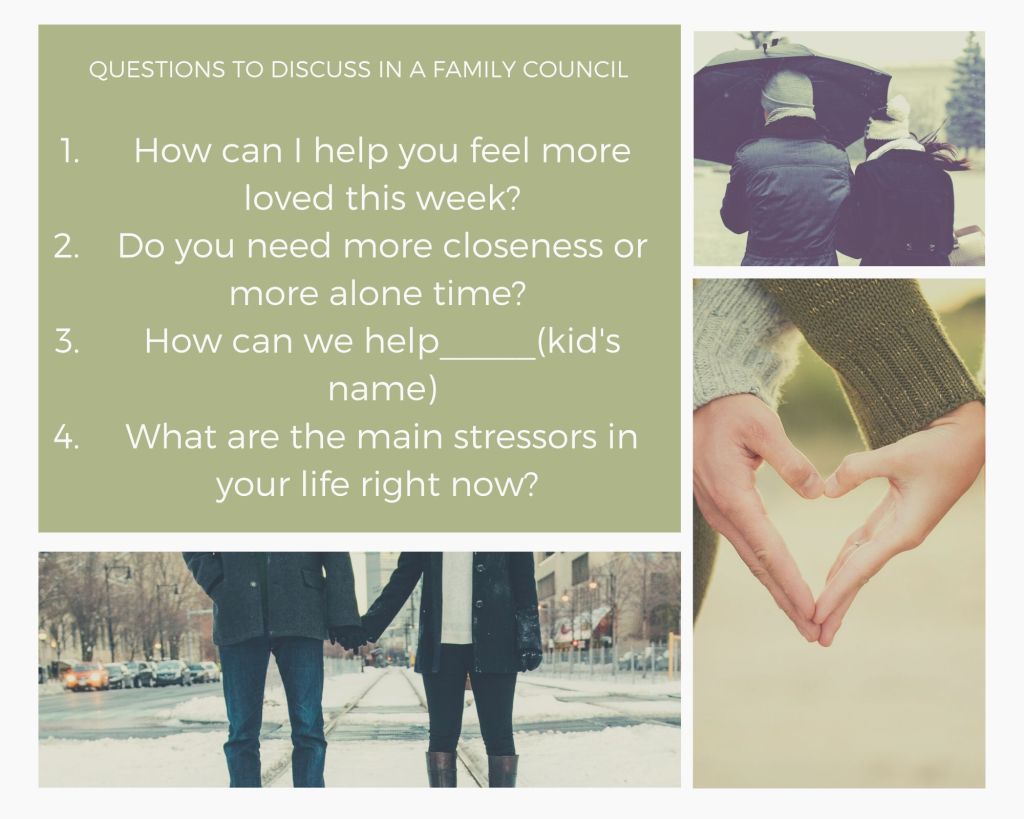
What can a couple do to resolve conflicts effectively? First, avoid these 4 Horsemen. Second, talk about these differences in family council.
The concept of “family council” since 1949 is found in the Philippine Civil Code in Title VII, Chapter 3, Articles 242 to 244 in which it says, “the Court of First Instance may, upon application of any member of the family, a relative, or a friend, appoint a family council, whose duty it shall be to advise the court, the spouses, the parents, guardians and the family on important family questions”.(2019)
A family council is a meeting on any day of the week (Ballard, 2016) that aims to help its members to be more sensitive to the needs and interests of others; to set goals and to evaluate individual progress; create an atmosphere of respect, understanding, order, and harmony; and help couples formulate family plans and goals.
Ballard, in his book called Counseling with Our Councils (Ballard 1997) states that family councils «can contribute to order at home, offer a means to heal hurt feelings… and create an opportunity to teach.» In this same book, he mentions some steps to consider when making a family council:
1. Schedule the family council and report on the issues that will be discussed.
2. Begin the council with words of appreciation.
3. Talk about the issues with Christian qualities and be willing to listen.
4. Reach agreements.
5. End with words of appreciation again.
6. If possible, share a snack.
By implementing these tips, marriage can become more likely to succeed.
Don’t forget to give our opinion in this link. https://byui.az1.qualtrics.com/jfe/form/SV_9SjnPyoBVTZskzX
REFERENCES.
Ballard M. Rusell (2016 April) Family councils Ensign May 2016 pgs. 63-65
Ballard, M. Rusell. (1997). Counseling with our councils. Retrieved from http://www.ldshuelen.cl/estaca/obispos/Biblioteca/Rusell%20Ballard%20-El-Divino-Sistema-de-Consejos.pdf
Family council. (2019, March 8). Philippines Daily Inquirer [Makati City, Philippines]. Retrieved from https://link-gale-com.byui.idm.oclc.org/apps/doc/A577669453/GIC?u=byuidaho&sid=GIC&xid=a9a12f42
Gottman, J. M., & Silver, N. (2015). The seven principles for making marriage work : a practical guide from the country’s foremost relationship expert (Vol. [Second edition]). New York: Harmony. Retrieved from https://search-ebscohost-com.byui.idm.oclc.org/login.aspx?direct=true&db=nlebk&AN=840107&site=eds-live
Moods, Stressors, and Severity of Marital Conflict: A Daily Diary Study of Low-Income Families. By: McCormick, Meghan P., Hsueh, JoAnn, Merrilees, Christine, Chou, Patricia, Mark Cummings, E., Family Relations, 01976664, Jul2017, Vol. 66, Issue 3
Ribeiro-Ferreira, Manuel. (2014). El divorcio en Nuevo León: tendencias actuales. Papeles de población, 20(80), 193-215. Retrieved in October 26, 2019 from http://www.scielo.org.mx/scielo.php?script=sci_arttext&pid=S1405-74252014000200007&lng=es&tlng=es
Uchtdorf F.Dieter (2016 April) In praise of those who save. Ensign May 2016.
 MARRIAGE FIRST